
Emergency Medicine's Growing Role in Pain Medicine
When the River Meets the Forest: Bridging Emergency and Pain Medicine
Voices in Pain Medicine: When the River Meets The Forest: Bridging Emergency and Pain Medicine
Once upon a time, there was a woman who was on a journey to find a great treasure. She came to a river and had to make a raft to continue. It took great effort and time to construct it, but the raft was sturdy and strong. The raft supported her while she navigated through the long, winding river. After traveling on the raft for several weeks, she came upon a dense forest and noticed the river had ended. She could not see beyond the first thicket of trees and would now have to travel on foot. The woman thought to herself, “Maybe I should bring this raft just in case I need it later?”
A Shortage of Pain Medicine Fellowship Applicants
Chronic pain affects 1 out of 4 people in the United States (1). Whether it’s you, a family member, or a close friend in pain, there may not be enough pain specialists to treat their pain in the coming years. Why? There has been a drop in pain medicine fellowship applicants starting in 2023. In 2022, there were 548 applicants, which decreased to 454 applicants in 2026, based on ERAS data released on April 1, 2026.
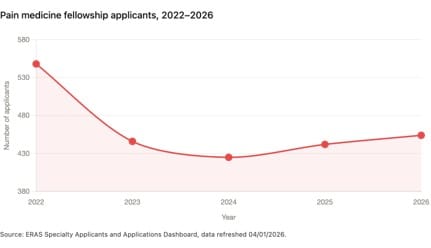
Data from AAMC ERAS Statistics – Retrieved April 3, 2026.
Assuming the usual attrition from ERAS applicants to those who participate in the NRMP Match process in 2026, there will likely be ~0.9 applicants per fellowship position. This means that a number of pain fellowship programs will remain partially unfilled. In 2020, 90% of programs were filled, but 75% were filled in 2025 (3).
Historically, anesthesiologists have made up the largest share of pain fellowship applicants. This is unsurprising since modern pain medicine has its roots within anesthesiology. The American Board of Anesthesiology was the first recognized specialty to obtain subspecialty approval in 1991 by the American Board of Medical Specialties (4). This was followed by Psychiatry and Neurology and PM&R in 1998, Family Medicine and Emergency Medicine in 2014, and Radiology in 2015 (4).
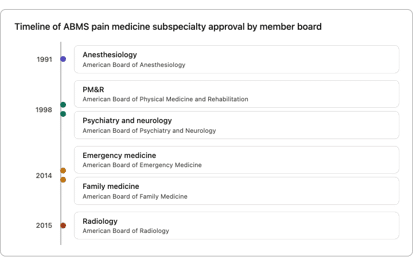
Data from American Board of Medical Specialties, ABMS Board Certification Report 2024-2025.
However, recent trends show a significant decline in applications from anesthesiologists, with 351 applicants in 2019 declining to 106 in 2025, representing a 70% drop (3,5). Assuming this trend continues into the 2026 application cycle, they will make up approximately 22% of applicants, compared to 67% in 2019. Pain medicine needs a new pipeline, and one seems to be forming. 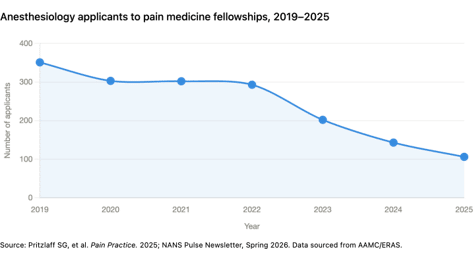
Emergency Physicians Entering Pain Medicine Fellowships
Emergency physicians applying to pain medicine fellowships have increased more than 500% from 2019 to 2025, rising from 10 to 61 applicants (3,5). Furthermore, a survey showed that 93.1% of program directors reported an increase in applicants from emergency medicine (EM) (6). 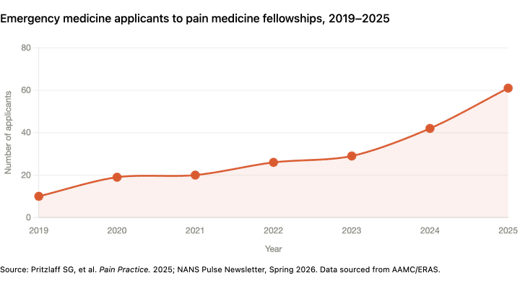
In a survey published in 2022, program directors ranked emergency medicine as one of the lowest preferred specialties with an average of 1.82 out of 5, while the highest preferred specialty was anesthesiology with an average of 4.49 out of 5.7 While these preferences may have shifted given the growing presence of EM applicants in recent years, no updated survey data are currently available for comparison.
Pain medicine is unique among specialties in that it draws knowledge from anesthesiology, neurology, psychiatry, physical medicine and rehabilitation, radiology, and psychology. Due to the nature of pain, it is a discipline that requires fluency across many fields.
Dr. John J. Bonica, widely regarded as the founding father of modern pain medicine, became convinced that: “Complex pain problems could be more effectively treated by a multidisciplinary/interdisciplinary team, each member of which would contribute their specialized knowledge and skills to the common goal of making a correct diagnosis and developing the most effective therapeutic strategy.” (8)
Emergency medicine is also a field that requires skills and knowledge from multiple specialties. That same multidisciplinary fluency (i.e., the ability to move across clinical domains without losing focus) is precisely what emergency training builds. EM residency programs include diverse experiences with rotations in OB/GYN, anesthesia, orthopedics, critical care, and surgery. Emergency physicians already have experience with incorporating multiple realms into one arena, creating a natural transition as they enter the field of pain medicine (9).
EM Training Competencies and Gaps
Drs. Merz-Herrala, Ocampo, and colleagues at the University of California, San Francisco published a timely study addressing emergency physicians pursuing pain medicine fellowship in Interventional Pain Medicine in 2026 (10). They systematically compared ACGME pain medicine fellowship requirements with core emergency medicine training to identify overlaps and gaps across three domains: 1) patient care, 2) procedural, and 3) medical knowledge. Some areas of significant overlap include acute pain management and procedural sedation, partial overlap in joint injections and nerve blocks, and minimal overlap in fluoroscopy-guided procedures. Of note, these gaps may be common among entering fellows, regardless of background specialty (10). Figure 1 below summarizes the competency overlaps and gaps in greater detail.
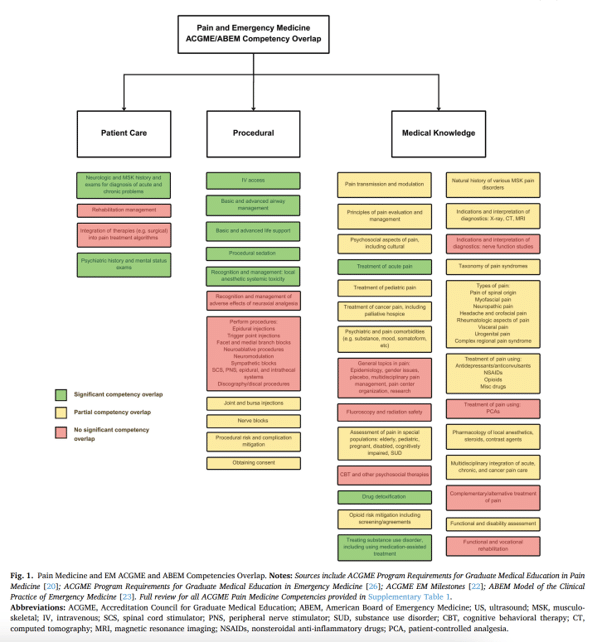
Source: Reprinted with permission from Merz-Herrala JR, et al. Interventional Pain Medicine. 2026;5:100722.
 Dr. Sayed E. Wahezi (President-Elect of the American Academy of Pain Medicine and program director of the Montefiore Einstein Multidisciplinary Pain Fellowship) notes some strengths of emergency physicians, saying, “They are enthusiastic, quick learners, manually skilled, have the ability to communicate with different specialties, and are comfortable in the O.R.” (11)
However, there may be some limitations, specifically with “understanding long-term chronic pain, the constantly changing psychology of patients with chronic pain, and what to do when a patient presents in a different pain-induced mood state.” (11)
Dr. Wahezi understands these skills can actually take years to develop and thus advocates for an evolution in pain medicine training.
When asked what advice he would give to a pain fellowship director who has yet to train an EM pain fellow, he advises, “Although the easiest thing may be to have an EM trained fellow just do procedures and transactional duties, that doesn’t benefit the fellow, our field, or our patients in the long term.” (11)
Integration of Emergency Physicians into Pain Medicine
As more emergency physicians enter pain fellowship training, program directors can consider adding flexibility in the curriculum. Specifically, by tailoring the training to reduce redundancies in areas where emergency physicians already have proficiency (e.g., airway refresher days, basic ultrasound skills) and instead use that time to focus on known gaps (e.g., fluoroscopy, functional restoration, cognitive behavioral therapy strategies)
Given that current pain medicine fellowship training is condensed into a single year, each training day is precious. It will be prudent for an EM-trained pain fellow to reflect on their own individual strengths and weaknesses, proactively communicate with their program directors, and seek out dedicated mentorship in organizations like the American Academy of Pain Medicine to advance successfully in the field.
Some programs may be hesitant or have reservations about recruiting emergency physicians into their program due to their lack of experience with them. However, other programs recognize that thoughtfully selected emergency physicians can synergize well with pain medicine to create a more robust, multi-dimensional fellowship cohort.

Dr. Moses Graubard graduated from the Harbor-UCLA emergency medicine residency program in 2010, and practiced as an ED attending for several years. In 2015, he learned about pain medicine as a subspecialty option for emergency physicians and felt called to make the transition.
He reflects, “The crux of ED work is extreme multitasking at speed, and there is almost no limit to the amount of task saturation one may be expected to handle. I felt like I was constantly working against my basic nature, and it was a never-ending source of stress – much more so than the emergencies themselves, which I felt trained to handle.”
Furthermore, he adds, “Ultimately, I realized that I prefer serial processing versus parallel processing, a regular schedule, and longitudinal relationships with patients. Pain medicine is much more sustainable and fulfilling for me in the long term. And it still involves the same satisfying mix of diagnostic challenges, medical treatment, and procedural treatment that drew me to emergency medicine in the first place. In fact, I now spend much more of my time doing procedures than I did when I worked in the ED.” (12)
Dr. Graubard was the first emergency physician to graduate from the Keck School of Medicine of the University of Southern California pain medicine fellowship program in 2019. After completing his pain medicine fellowship, he initially worked in both settings, and eventually progressed into pain medicine full-time. He is now the Chief of Pain Medicine at Kaiser Permanente Oakland in Northern California.
Conclusion
Pain medicine is at a pivotal moment. The field is not shrinking, but rather it is diversifying, and that distinction matters. The old pipeline may be narrowing, but new ones are forming. By actively recruiting emergency physicians through collaboration with organizations such as the American College of Emergency Physicians (ACEP), the American Academy of Emergency Medicine (AAEM), and the Emergency Medicine Residents’ Association (EMRA), and tailoring training to their background, pain medicine can emerge stronger, more diverse, and better positioned to serve the patients who need it most.
Finally, to go back to the beginning of the story, the woman decided to let go of her raft at the edge of the river. It had served her well when she needed it. She took a step into the forest towards her treasure.

American Academy of Pain Medicine Emergency Medicine Special Interest Group
H. Samuel Ko, MD
Jessica C. Oswald, MD
Jonathan B. Lee, MD
Joshua K. Perese, MD
Philip S. Fallah, MD
Emergency Medicine SIG
AAPM Emergency Medicine SIG Members
References
- Lucas JW, Sohi I. Chronic pain and high-impact chronic pain in U.S. adults, 2023. NCHS Data Brief, no. 518. Hyattsville, MD: National Center for Health Statistics; 2024. doi:10.15620/cdc/169630
- Association of American Medical Colleges. ERAS statistics: fellowship — pain medicine (multidisciplinary). ERAS Specialty Applicants and Applications Dashboard. Data last refreshed April 1, 2026. Available at: https://www.aamc.org/data-reports/publication/eras-statistics
- Pritzlaff SG. Pain medicine fellowship at a crossroads: recalibration, not retreat. NANS Pulse Newsletter. Spring 2026:1-3.
- American Board of Medical Specialties. 2024-2025 ABMS Board Certification Report. Table 1B: Approved subspecialty certificates by ABMS member board. Chicago, IL: ABMS; 2025. Available at: https://www.abms.org/wp-content/uploads/2025/12/2024_25_ABMSCertReport_FNL_20251212.pdf
- Pritzlaff SG, Singh N, Sanghvi C, Jung MJ, Cheng PK, Copenhaver D. Declining pain medicine fellowship applications from 2019 to 2024: a concerning trend among anesthesia residents and a growing gender disparity. Pain Pract. 2025;25(1):e13441. doi:10.1111/papr.13441
- Jueng J, Pritzlaff SG, Mehta N, Gulati A, Schatman ME, Wahezi SE, Day M, Durbhakula S, Pak DJ. Analyzing trends in the pain fellowship match: a survey of program directors. J Pain Res. 2025;18:2335-2341. doi:10.2147/JPR.S496104
- Tieppo Francio V, Gill B, Hagedorn JM, Pagan Rosado R, Pritzlaff S, Furnish T, Kohan L, Sayed D. Factors involved in applicant interview selection and ranking for chronic pain medicine fellowship. Reg Anesth Pain Med. 2022;47(10):592-597. doi:10.1136/rapm-2022-103538
- Bonica JJ. Evolution and current status of pain programs. J Pain Symptom Manage. 1990;5(6):368-374.
- Solis E, Barad M, Wahezi SE. Chronic pain fellowships and emergency medicine residency: similarities and synergy. Pain Med. 2025;26(10):629–630. doi:10.1093/pm/pnaf050
- Merz-Herrala JR, Ocampo F, Abrecht CR, Arevalo JB, Chai NC. Emergency physicians in pain medicine: workforce trends, competency overlap, gaps, and opportunities for integration. Interv Pain Med. 2026;5:100722. doi:10.1016/j.inpm.2025.100722
- Wahezi SE. Telephone interview and email communication with H. Samuel Ko, MD. March 14, 2026 and April 7, 2026.
- Graubard M. Telephone interview and email communication with H. Samuel Ko, MD. January 27, 2026 and April 7, 2026
As part of our commitment to advancing pain care across disciplines, AAPM periodically highlights significant work from across the field. Articles written by our guest blog authors are their own and do not necessarily reflect those of their institutions or the American Academy of Pain Medicine.
Voices in Pain Medicine highlights perspectives from across the AAPM community, including physicians, trainees, APPs, researchers, and other pain medicine professionals. Have a story, clinical insight, career reflection, or opinion to share? We’d love to hear from you. Submit a blog idea here!