
Patient Population
Adults with atraumatic acute low back pain lasting less than six weeks, with or without radiculopathy.

Practical, research-informed recommendations for adults with atraumatic acute low back pain lasting less than six weeks, with or without radiculopathy, to support shared decision-making in outpatient care.
Recommendations are intended to inform shared decision-making and are not intended to restrict, limit, delay, or deny coverage or access to clinically appropriate prescriptions.
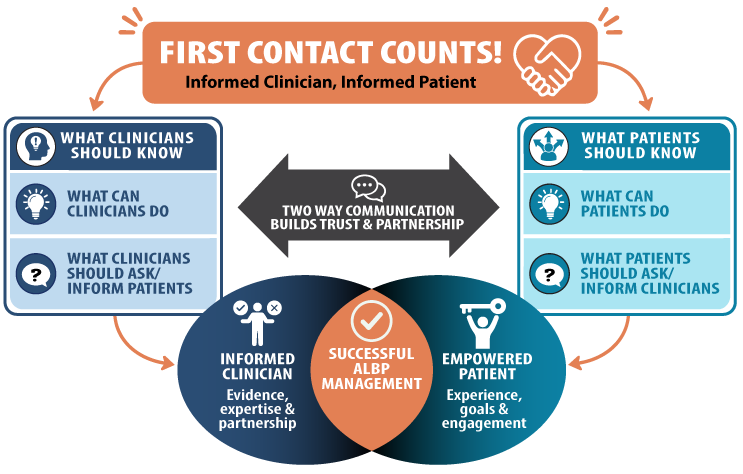
Adults with atraumatic acute low back pain lasting less than six weeks, with or without radiculopathy.
Outpatient and ambulatory care.
Stepwise care beginning with lower-risk options and supported by shared decision-making.
Avoid routine imaging and do not routinely use opioids as initial treatment.
A practical, case-informed overview of the guideline recommendations, focused on real-world application in outpatient care and shared decision-making.
What you will learn:

Low back pain is a leading cause of disability and contributes substantially to healthcare utilization and cost. This guideline synthesizes evidence from a systematic review and uses the GRADE framework to inform recommendations that clinicians can adapt to individual patient circumstances.
The work was developed by the Oregon Health & Science University Evidence-based Practice Center, Aggregate Analytics, Inc., and the American Academy of Pain Medicine, with support from FDA/HHS.
Designed for personalized care, not a rigid pathway. The recommendations in this Assessment and Treatment of Acute Low Back Pain guideline are intended to guide a personalized medicine approach to patient care and not serve as a strict clinical pathway to substitute for individual clinician judgment on a patient-by-patient basis. Consistent with the SUPPORT Act, this guideline, together with the patient-facing materials, is intended to help inform clinical decision-making by prescribers and patients. They are not intended to be used for the purposes of restricting, limiting, delaying, or denying coverage for, or access to, a prescription issued for a legitimate medical purpose by an individual practitioner acting in the usual course of professional practice.
Use this summary as a quick overview. Consult the full guideline for the complete recommendations, rationale, evidence summaries, certainty ratings, and implementation considerations.
Need the full detail? Access the full guidelineAccess the full guideline.
Reassess symptom trajectory and function. Consider psychosocial “yellow flags,” including fear-avoidance, coping, stress or distress, mood, and anxiety, that may influence recovery. Tailor support and care accordingly.
Imaging and Assessment
Obtain imaging when signs, symptoms, or risk factors suggest serious spine pathology. In uncomplicated acute low back pain, routine imaging does not improve pain, function, or recovery and may increase labeling or anxiety, cost, downstream testing or referrals, and radiation exposure from x-ray or CT.
Start With Self-Management
If Worse or Unchanged After 1–2 Weeks
Options are not listed in priority order.
Choose options based on patient preferences, health status and contraindications, prior response, availability, safety, access, and cost. Expected benefits are generally modest and short-term.
Radiculopathy Only - Low Certainty Evidence
In addition to the options above, clinicians may consider:
There is no evidence supporting these options for isolated nonradicular back pain. Benefits are limited and generally temporary. Use shared decision-making and continue activity, self-management, and physical therapy when possible.
Opioids - Low Certainty evidence
For most patients, opioids are not indicated as first-line therapy. Evidence shows little or no short-term benefit for pain or function, while opioids carry important risks.
Download, use, and share these resources within your practice.
Complete recommendations, rationale, certainty ratings, and evidence summaries for assessment and management.
A concise, printable reference to support point-of-care decision-making and consistent communication.
Practical language to explain options and trade-offs, set expectations, and align care with patient goals.
Review the evidence base used to inform development of the acute low back pain recommendations.
Reinforce self-management, appropriate activity, informed questions, and reliable sources of information.
 Patient Checklist A practical check-in tool patients can use before and during a clinical visit.
 Myth vs. Fact Clear answers to common misconceptions about imaging, movement, recovery, and treatment.
 Patient Resource Table A curated collection of reliable education, activity, exercise, and self-management resources.
Looking for the complete patient resource collection? Visit the Acute Low Back Pain Patient Resources page.
Hear clinical and patient perspectives on applying the guideline, supporting shared decision-making, and communicating recommendations clearly.
Explore practical considerations for applying the guideline in everyday outpatient care.
Listen to the clinician episodeConsider communication, trust, and patient engagement through the perspective of a patient advocate.
Listen to the patient advocate episodeFunding and attribution: This project is supported by the Food and Drug Administration (FDA) of the U.S. Department of Health and Human Services (HHS) as part of a financial assistance award (FAIN) totaling $1,999,980, with 100 percent funded by FDA/HHS. The content is that of the author(s) and does not necessarily represent the official views of, nor any endorsement by, FDA/HHS or the U.S. Government.
Oregon Health & Science University Evidence-based Practice Center, Aggregate Analytics, Inc., and the American Academy of Pain Medicine. Assessment and Treatment of Acute Low Back Pain, 2026.
Ready to apply the guideline in practice?